
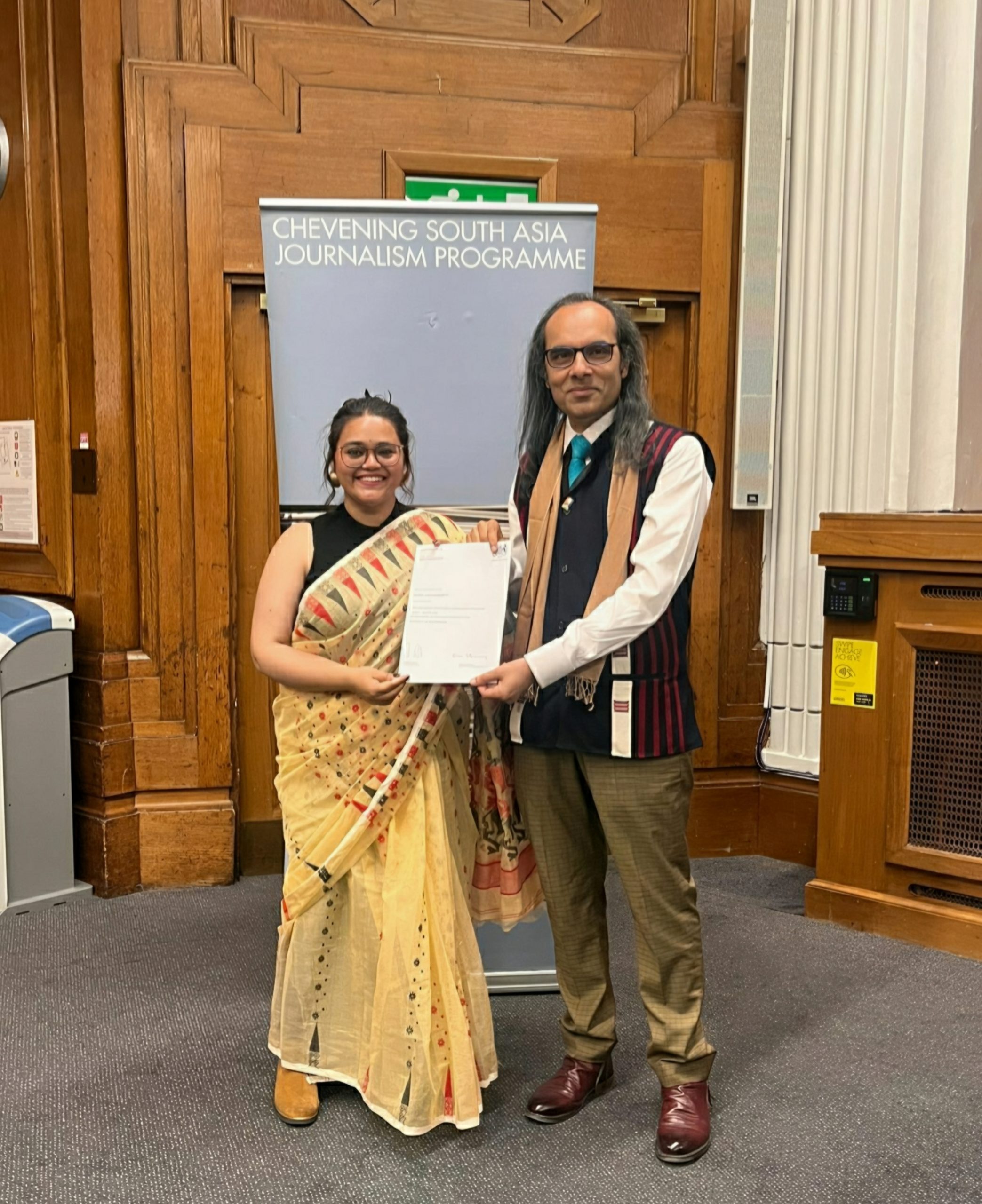
Rupsa Chakraborty’s Chevening story: From newsroom to national influence
Rupsa shares how the Chevening South Asia Journalism Fellowship helped her tackle misinformation, inform policy, and create lasting impact in the public health space.

For more than 14 years, journalism has been Rupsa Chakraborty’s instrument for change. As a health reporter in India, Rupsa has documented hospital crises, investigated policy failures, and exposed systemic injustices affecting the country’s most vulnerable communities. Her reporting has informed parliamentary debate, contributed to Maharashtra’s first Climate-Health Action Plan, and helped release government funding for 13 critically ill children after an investigation into rare disease care was submitted as evidence in court.
But the Chevening South Asia Journalism Fellowship (SAJP) transformed how she approaches her work:
Before joining the SAJP Fellowship, Rupsa’s work was largely rooted in health and science reporting. Chevening expanded that perspective, transporting her back to a world of academia and research and motivating her to bridge the gap between evidence and policy, a gap journalists often struggle to close for lack of academic training.
The fellowship also opened doors to some of the United Kingdom’s most respected news organisations. Visits to The Economist, the BBC, and The Guardian gave her the opportunity to engage with senior editors about protecting editorial independence and maintaining public trust in an era of AI-generated misinformation. Sessions with academics and editors, including Dr Kamran Abbasi, editor-in-chief of The BMJ, challenged her to think more critically about medical writing, evidence, and the responsibilities of modern journalism.
The programme culminated in a symposium at the University of Westminster, in which fellows explored the topic of whether democracy is safe in the smart age, with a particular focus on the role generative AI played during recent elections in India, Pakistan, and Bangladesh.
The impact of Chevening has extended well beyond Rupsa’s own career:
One of the SAJP Fellowship’s most enduring legacies has been the network it has created across South Asia. For example, when cross-border reporting became difficult, trusted colleagues from neighbouring countries helped Rupsa report stories she could not have covered alone.
Rupsa was also able to apply what she learnt about misinformation to counter myths that discourage families from accessing a vaccine proven to prevent cervical cancer.
But equally important to her work has been her commitment to sharing these opportunities with others. Rupsa now mentors prospective Chevening applicants and has been invited by the National Press Foundation to speak to its international rare disease fellowship, passing on lessons in both journalism and research.
Her investigative reporting continues to produce measurable impact:
Rupsa’s investigation into India’s failure to fund treatment for rare genetic diseases helped trigger the release of pending government funds for 13 critically ill children. Another investigation, using India’s Right to Information Act, exposed the scale of ragging on university campuses by documenting 78 student deaths over a decade and revealing widespread failures to implement mandatory anti-ragging measures. The findings prompted a response from India’s University Grants Commission and became part of the national debate on student safety.
Chevening also laid the foundation for Rupsa’s growing work at the intersection of climate and public health:
As principal investigator, Rupsa is now leading one of India’s first pilot studies on occupational heat stress among Anganwadi workers through a UK-India collaboration between LSE and IIHMR Delhi, supported by the Delhi government. Alongside her research, she continues to write for international public health platforms including Health Policy Watch and Global Health NOW.
Her most recent BMJ investigation into how climate change is reshaping India’s snakebite crisis demonstrates how journalism and research now reinforce one another. Featured by LSE’s Department of Health Policy during London Climate Action Week 2026, the investigation combined scientific evidence with deeply reported human stories to show how climate change is expanding snake habitats while exposing failures in antivenom policy and disease surveillance. By reframing snakebite as both a climate and public health issue, the reporting helped bring a neglected rural emergency into mainstream policy discussions.
For Rupsa, that represents the lasting impact of Chevening:
Becoming a Chevening fellow sharpened the journalism skills Rupsa had developed over more than a decade while giving her the academic tools to interrogate evidence, compare health systems, and strengthen the policy relevance of her reporting. Today, she approaches every investigation with both the curiosity of a journalist and the discipline of a researcher.
Her ambition remains unchanged: to produce journalism that not only documents what is broken but helps inform the decisions that can repair it.